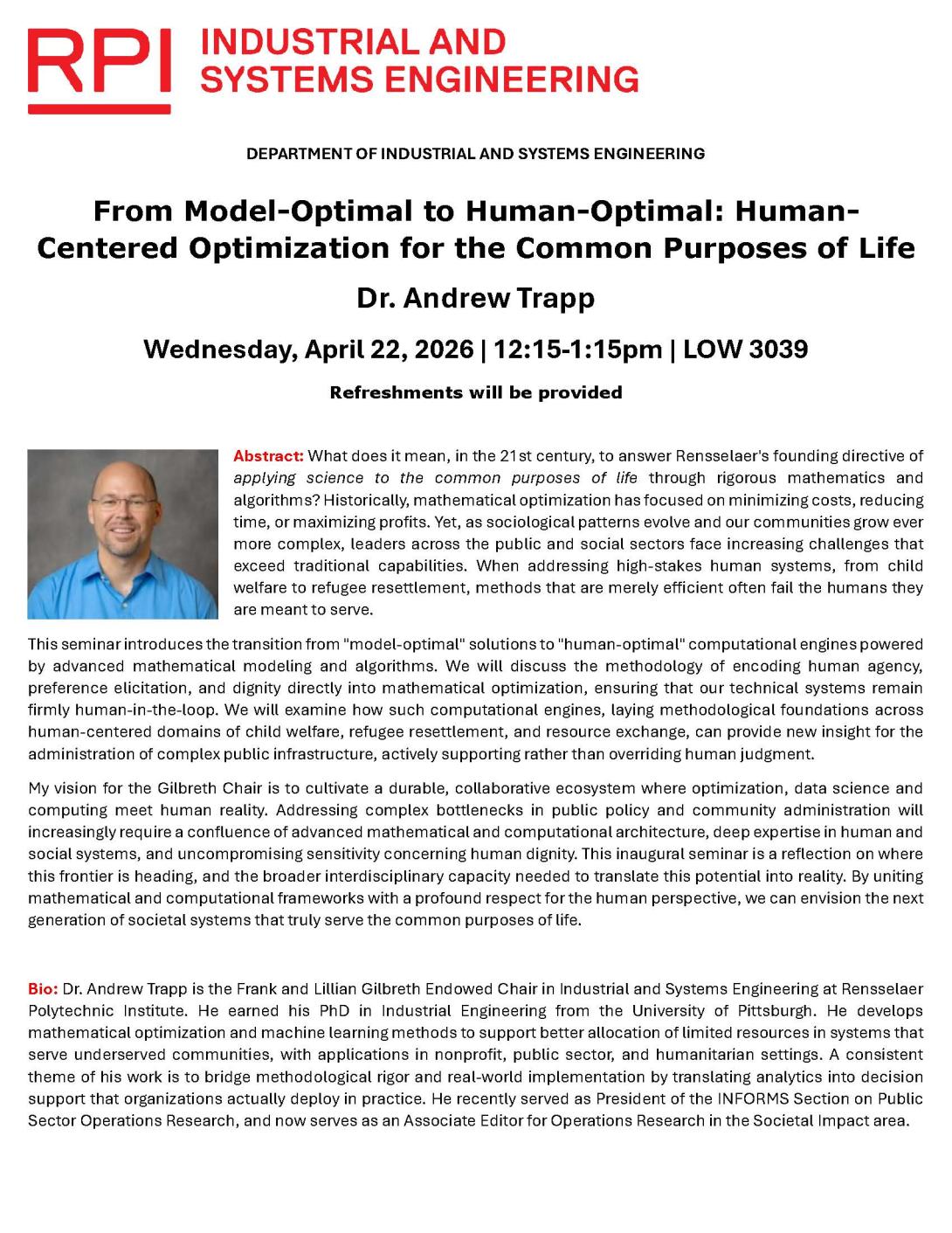
What does it mean, in the 21st century, to answer Rensselaer's founding directive of applying science to the common purposes of life through rigorous mathematics and algorithms? Historically, mathematical optimization has focused on minimizing costs, reducing time, or maximizing profits. Yet, as sociological patterns evolve and our communities grow ever more complex, leaders across the public and social sectors face increasing challenges that exceed traditional capabilities. When addressing high-stakes human systems, from child welfare to refugee resettlement, methods that are merely efficient often fail the humans they are meant to serve.
This seminar introduces the transition from "model-optimal" solutions to "human-optimal" computational engines powered by advanced mathematical modeling and algorithms. We will discuss the methodology of encoding human agency, preference elicitation, and dignity directly into mathematical optimization, ensuring that our technical systems remain firmly human-in-the-loop. We will examine how such computational engines, laying methodological foundations across human-centered domains of child welfare, refugee resettlement, and resource exchange, can provide new insight for the administration of complex public infrastructure, actively supporting rather than overriding human judgment.
My vision for the Gilbreth Chair is to cultivate a durable, collaborative ecosystem where optimization, data science and computing meet human reality. Addressing complex bottlenecks in public policy and community administration will increasingly require a confluence of advanced mathematical and computational architecture, deep expertise in human and social systems, and uncompromising sensitivity concerning human dignity. This inaugural seminar is a reflection on where this frontier is heading, and the broader interdisciplinary capacity needed to translate this potential into reality. By uniting mathematical and computational frameworks with a profound respect for the human perspective, we can envision the next generation of societal systems that truly serve the common purposes of life.
Dr. Andrew Trapp is the Frank and Lillian Gilbreth Endowed Chair in Industrial and Systems Engineering at Rensselaer Polytechnic Institute. He earned his PhD in Industrial Engineering from the University of Pittsburgh. He develops mathematical optimization and machine learning methods to support better allocation of limited resources in systems that serve underserved communities, with applications in nonprofit, public sector, and humanitarian settings. A consistent theme of his work is to bridge methodological rigor and real-world implementation by translating analytics into decision support that organizations actually deploy in practice. He recently served as President of the INFORMS Section on Public Sector Operations Research, and now serves as an Associate Editor for Operations Research in the Societal Impact area.
All are welcome to attend!